



The Internet of Things is no longer emerging. It is embedded in how people live and work. From connected home devices to industrial sensors and enterprise platforms, IoT continues to scale rapidly, with billions of devices already in use and more coming online every year.
Yet despite this growth, many IoT products still struggle to deliver meaningful, intuitive user experiences.
The challenge is not the technology itself. It is how that technology fits into real human behavior. Too often, IoT products are engineered for capability rather than usability. They offer powerful features but fall short in everyday execution.
At UpTop, we see this as a product experience challenge. The organizations that succeed are not the ones with the most advanced devices. They are the ones that continuously optimize how those devices integrate into real workflows and deliver measurable value over time.
Here are four modern principles for designing IoT experiences that drive adoption, satisfaction, and long-term performance.
1. Focus on Real-World Value, Not Features
The success of any IoT product depends on one thing: whether it makes life easier in a meaningful way.
Many connected devices are introduced with a long list of features, but features alone rarely drive adoption. Users do not buy IoT products because they are “smart.” They adopt them because they solve real problems.
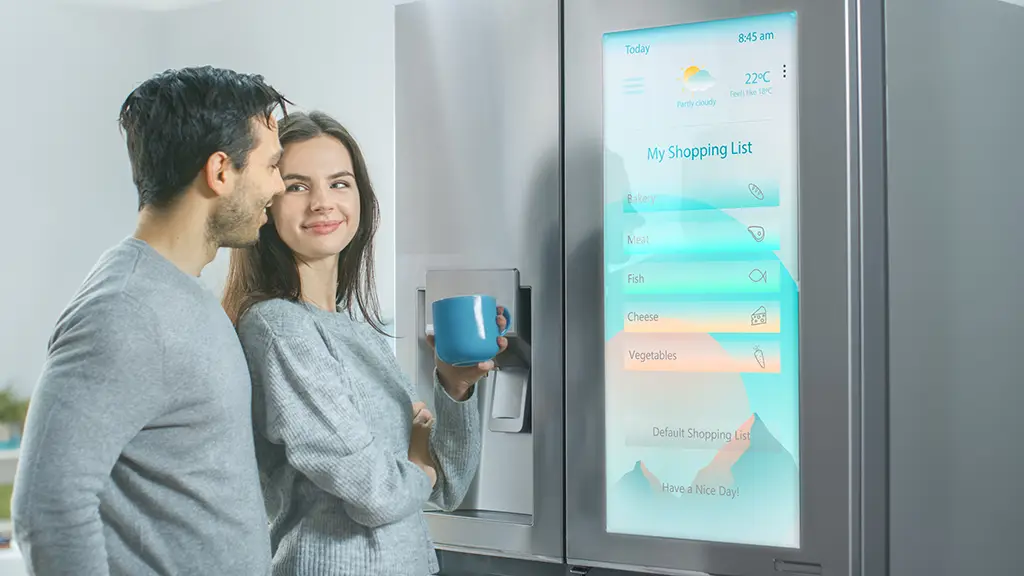
Consider a connected appliance like a smart refrigerator. The value is not in having a screen or remote controls. The real benefit comes from reducing friction in everyday tasks. Monitoring food freshness, suggesting what to use next, or simplifying grocery planning are examples of value that align with real behavior.
This is where UX plays a critical role.
Strong IoT UX begins with understanding:
- What tasks users are trying to complete
- Where friction exists in those tasks
- What can be automated or simplified through connectivity
At UpTop, this often starts with behavioral research and journey mapping. Instead of designing around what a device can do, we design around what users need to accomplish.
The goal is to embed the product into daily routines in a way that feels natural. When that happens, the technology becomes invisible and the value becomes obvious.
2. Design for an Ecosystem, Not a Single Interface
Early IoT experiences were heavily centered on mobile apps. Devices relied on companion apps for control, monitoring, and configuration.
Today, the interaction model is far more complex.
Users engage with IoT devices across multiple touchpoints:
- Mobile applications
- Voice assistants
- Web dashboards
- Physical interfaces on the device itself
- Automated triggers and integrations with other systems
This shift requires a broader design perspective. IoT UX is no longer about a single interface. It is about orchestrating a connected ecosystem.
Voice interaction is a clear example. Platforms like Alexa, Google Assistant, and Siri have changed how users control devices. Instead of navigating menus, users expect to issue simple commands and receive immediate responses.
Designing for this environment requires:
- Clear, predictable system responses
- Thoughtful handling of edge cases and errors
- Consistent behavior across platforms
- Seamless transitions between touchpoints
It also requires strong integration design. Users do not think in terms of platforms or APIs. They expect their devices to work together without friction.
At UpTop, we approach this as a systems design challenge. The goal is to create cohesive experiences across channels, ensuring that every interaction feels connected and intentional.
3. Reduce Complexity While Expanding Capability
IoT products are inherently complex. They involve sensors, data processing, connectivity, and automation. But users should not have to manage that complexity.
One of the most common pitfalls in IoT design is overexposing functionality. Teams try to surface every feature, every data point, and every configuration option.
This often leads to overwhelming interfaces that slow users down.
Effective UX does the opposite. It simplifies the experience without limiting what the product can do.
This involves:
- Prioritizing the most important actions and information
- Hiding advanced functionality until it is needed
- Using progressive disclosure to introduce features over time
- Automating decisions where possible
For example, instead of requiring users to configure detailed settings, a system might learn behavior patterns and adjust automatically. When manual control is needed, it should be easy to access but not intrusive.
Simplicity is not about removing capability. It is about presenting it in a way that aligns with user intent.
This is especially important in enterprise IoT environments, where users may interact with systems under time pressure. Clear, efficient interfaces directly impact productivity and accuracy.
4. Design for the Full Experience Lifecycle
Many IoT products fail not because of what they do, but because of how they are introduced.
The first experience matters. If setup is confusing or time-consuming, users may never fully adopt the product.
UX design must extend beyond the core interface to cover the entire lifecycle:
- Unboxing and first impressions
- Setup and onboarding
- Device pairing and configuration
- Ongoing usage and maintenance
- Troubleshooting and support
Each of these touchpoints shapes perception and long-term engagement.
Research consistently shows that users rarely read instructions in detail. They rely on intuitive design and guided experiences to get started.
This means onboarding should be:
- Clear and step-by-step
- Contextual, providing help when needed
- Designed to deliver value quickly
At UpTop, we often evaluate onboarding as part of a broader product optimization effort. Small improvements in setup flows can significantly increase activation rates and reduce support costs.
Beyond onboarding, the experience should continue to evolve. As users become more familiar with the product, they should be able to unlock additional value without friction.
From Launch to Continuous Optimization
One of the biggest shifts in how IoT UX is approached today is the move from static design to continuous improvement.
Historically, teams would design a product, launch it, and then focus on the next release cycle. Today, leading organizations treat IoT experiences as ongoing products that require constant refinement.
This is where UpTop’s Product Optimization and Continuous Improvement approach becomes critical.
Rather than relying on assumptions, teams can:
- Track how users interact with devices and interfaces
- Identify friction through behavioral analytics
- Gather real-time feedback from users
- Iterate on features and workflows based on performance
This creates a feedback loop where the product continuously improves over time.
For IoT, this is especially important. Connected devices generate rich data that can be used to enhance the experience. The organizations that leverage this data effectively gain a significant advantage.
Creating a Competitive Advantage Through Experience
As the IoT market continues to grow, differentiation is becoming harder. Hardware capabilities are quickly matched. Features are replicated. Pricing becomes competitive.
User experience is where lasting advantage is created.
Organizations that invest in UX are better positioned to:
- Drive higher adoption and engagement
- Reduce support and operational costs
- Increase customer satisfaction and loyalty
- Deliver more consistent performance across products and platforms
This is true for both consumer and enterprise IoT solutions.
At UpTop, we partner with organizations to ensure their connected products are not just functional, but effective. Through research, UX strategy, and continuous optimization, we help teams create experiences that align with real-world behavior and deliver measurable outcomes.
Moving Forward
The opportunity in IoT is not just in building smarter devices. It is in creating smarter experiences.
By focusing on real user value, designing across ecosystems, simplifying complexity, and optimizing the full lifecycle, organizations can turn connected products into meaningful solutions.
The path forward is clear. Treat IoT as an experience, not just a technology.
When the experience works, everything else follows. Let’s discuss.